Kuching Part Three
We took off heading for the “old longhouse.” Stewart explained
that the longhouse was over 80 years old and that until a road had been laid
a few years earlier, the only way to reach it was on foot through a thin jungle
path, reportedly a two hour walk. Whoa. We eventually pulled up to a much more
run down longhouse. This one was also seemingly built in sections, though Stewart’s
mom insisted that it had been built all at once. The exterior was partly built
in brick, but mostly it was hardwood. The roof again was corrugated tin. While
there was forced running water from a nearby mountain, there was no electricity.
It was going on 6:00PM when we pulled up, so the inside was very dim. The Germans
and I wandered around as Stewart and his mom got the kitchen going for dinner.
The layout of this dwelling was reversed. The “front” had the toilet
and shower stall, inside the door was the gigantic kitchen/eating/communal area,
the next room was equally giant, serving as storage and sleeping quarters and
finally the communal “porch” before the chicken coups and pigpens.
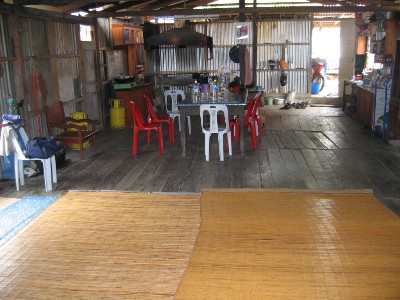
The kitchen/eating/social room |
Several neighbors and distant relatives appeared out of nowhere and alternated
between helping Stewart and standing around shyly staring at us. We sat out
on the communal porch for a while, taking pictures and playing with a couple
of the kids. They went bananas over my digital camera. I took their picture
and then showed them the picture on the little display screen which was a source
of constant delight for the rest of our stay. Every time I got out my camera
the kids jumped in front of whatever I was trying to shoot, so they could see
their pictures again. The German woman broke out some candy she brought along
for gifts and this distracted the kids long enough for me to take long exposure
shots of the fading interior of the porch. This longhouse had 36 dwellings,
with over 100 residents, but you wouldn’t know it walking down the porch.
Absolutely no noise was being emitted from any of the dwellings, but Stewart
assured us that there were dozens of people hiding behind those doors. Since
there was no electricity, there was no light either. It was very deceptive.
Just as I was starting to think that Stewart was putting us on, a door opened
right next to me. A young woman took a half step out, saw me, then backed up
and closed the door again.
Just as it was getting too dark to see clearly Stewart and one of his cousins
fired up a generator and florescent lights were turned out. While there was
a portable gas stove, Stewart did half of the cooking on a stone slab with a
wood fire. He stuffed a bunch of chicken and green, leafy vegetables into thick
bamboo shoots and laid these over the fire. Then he prepared some fried chicken,
rice and heated up some of the wild boar that his cousins had bagged the previous
day.
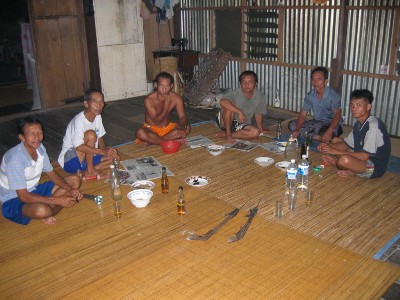
Some of the dinner guests. Note the slingshot spear guns in the foreground. |
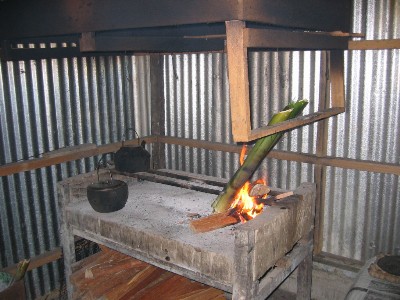
Bamboo baked chicken |
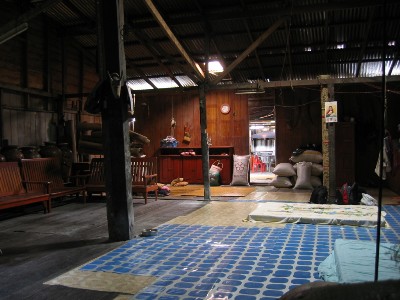
Storage/sleeping area. The sacks contain white pepper. |
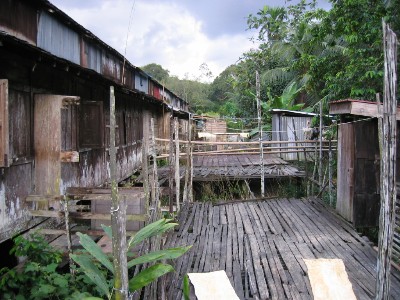
Back porch with rubber sheets drying in the foreground |
After our feast we settled down on the social mat to sit and
be stared at by friends and relatives. After some time, one of
Stewart’s cousins suggested that we go hunting. It was 9:00PM
and pitch black. The Germans looked uncertain and I flat out refused.
I was cross-eyed tired and ready for bed. Plus, I only had my
sandals, no proper shoes, and no pants to protect me from being
nicked by the less friendly shrubs. The Germans were eventually
persuaded to go. They suited up, smeared on bug repellant and
headed out with three guys from the tribe, none of whom spoke
English, armed with an ancient shotgun and a couple weak flashlights.
It was promised they would only be out for about 15 minutes.
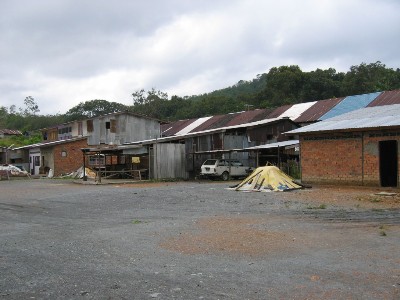
Out front |
Two hours later they returned exhausted, shell-shocked, sweaty, filthy, and
wet from a few unannounced river crossings. They looked like they had just run
through a car wash, using mud and sticks instead of soap and brushes. The girl
had been bitten by what she claimed was the world’s biggest ant. Nevertheless,
it had been a successful outing. The tribesmen had bagged four prey using only
four shots. Three “mouse deer” (like a regular deer but only about
a foot tall) and some kind of long-tailed, black jungle cat. To hear the Germans
tell it, the guys were running full speed, up and down hills and through streams
in the jungle, following their hunting dogs. At intervals, the guy with the
shotgun would suddenly pause and scan the air with some kind of invisible radar,
then disappear into the bushes. A few seconds later there would be a shot and
he’d re-emerge with a dead animal. It was uncanny. I had gone to sleep
as promised as soon as the the hunting party had set out, but Stewart roused
me to see the kill. The guys immediately stoked the fire on the cooking stone
and cooked the beasts. Two for eating immediately and two for taking back to
Kuching. I watched this for a few moments half-asleep before heading back to
my wafer-thin mat.
The post-hunt festivities raged on and kept me awake until about 1:00AM. Then
the roosters started going at it at about 5:00AM. So other then the fleeting
sleep I got during the hunt, I had managed to hoard only four more hours of
sleep that night, bringing the total to six hours in two nights. I was not feeling
very spry at breakfast.
In full daylight, I went around taking numerous pictures of the long house
and some of the obliging residents. I was also escorted to the spot where the
blackened skulls were hung in the communal porch. I had passed right under the
skulls two times the night before while I was exploring before dinner, but failed
to notice them in the dim light. In their heyday, the Iban were alleged to be
the most formidable of Borneo's headhunters. Stewart’s mom claims that
the Iban were actually very peaceful, but they were forced to take on a more
fierce attitude as various invaders encroached on their territory. According
to some quick online research the heads of their slain enemies were reportedly
hung in the longhouse at the conclusion of a massive festival called Gawai Kenyalang
(“Hornbill Festival”). They believed that the heads contained magical
powers that would “bring strength, virtue and prosperity to the longhouse.”
I was assured that this particular set of skulls was well over 100 years old
and that there hadn’t been any reason to relieve anyone of their craniums
in the interim.
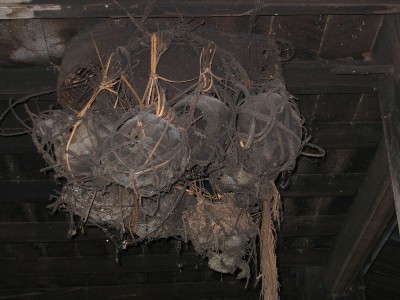
Blackened skulls |
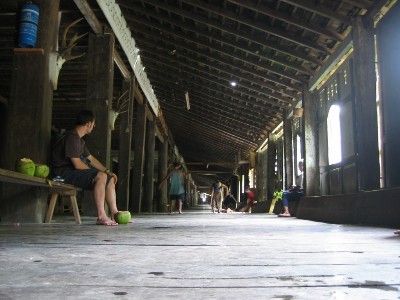
Communal porch |
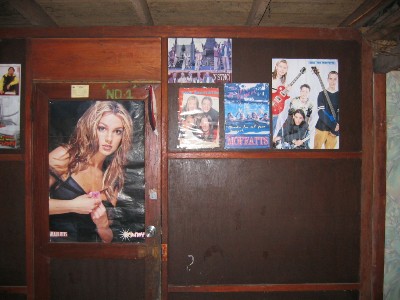
This was on one of the dwelling doors. Britney is taking over the world. |
 |
Taking pictures outside the house was a bit of a letdown. While the Iban keep
the interiors of their longhouses relatively spotless, they are not so concerned
about the state of the surrounding area. They seem to generally regard the jungle
as one big garbage can, starting as soon as you exit the porch. From the rickety
back platform, down past the chicken coups and out into the tangle of greenery,
there was trash randomly strewn everywhere. Cans, plastic bottles and even small
engine parts. The kids are programmed with this attitude early. When the kids
went to work on the candy the Germans gave them, they dropped the wrappers where
they stood without a care in the world.
While the longhouses themselves are surprisingly well kept considering they
are smack in the middle of the jungle, I should address the general hygienic
state that, if you’re anything like me, will challenge your capacity to
live in denial. As a recovering germophobe, it was nearly enough to spark a
relapse. The food preparation, the roaming cats and dogs, the toilet facilities
(although soap is available if you look hard enough, it is mainly regarded as
an unnecessary extravagance) and the kids dropping trou and pissing whenever
and wherever the urge hit them, playfully running their hands through the stream,
pushed my mind-over-matter abilities to their limits – as well as setting
my resolve to avoid any and all physical contact with the children.
Stewart took us around the explained how the tribesmen earn their modest living.
Considering that they can obtain virtually everything they need from the surrounding
jungle, their need for cash is nearly nonexistent, but with civilization slowly
encroaching on their lives, a little spending money doesn’t hurt. The
residents in the old long house maintained bountiful white pepper gardens that
produce a dozen or so 20 kilo sacks of pepper each season. There was an unusually
large stockpile of pepper during our visit. Stewart explained that pepper prices
had dropped over the previous two seasons, so the tribe was hoarding their stash
until prices rose again. Additionally, the tribe milked hundreds of rubber trees
in the area. A single tree doesn’t produce a heck of a lot of material,
so the process of slashing, setting up drip collectors and then going around
every few days to gather the material seemed tedious, but there was no denying
the result. The little dabs of collected material is heated using acid and rolled
into long, finger-thick sheets, which fetch a fair price. Finally, while there
wasn’t evidence that this was happening at the old longhouse, rice making
is also a moderate money earner for the Iban.
After some breakfast and the appropriate amount of sitting around and socializing
on the communal porch, while sipping the juice out of freshly picked coconuts,
it was suggested that we do some river fishing. I was very excited for this
as I had been examining the tribe’s homemade slingshot spear guns the
previous evening and I was keen to gun me down some fish. Several of the tribe
accompanied us, as well as about four dogs. A few men fished with nets and one
guy used the spear gun in concert with a waterproof flashlight (the water was
pretty soupy) and a snorkeling mask. I was not offered the spear gun, probably
for my own safety, and I was not interested in snorkeling in the muddy river
anyway. Somehow I had imagined that I would simply stand safely on shore and
pick off fish at my leisure, but alas it was not that easy. We followed the
tribesmen down the river as they netted and bagged little, sardine-sized fish.
The spear guy wasn’t having a good day. Eventually he managed to land
what looked to be a catfish, which he cleared out by sticking the fish’s
head in his mouth and sucking. Yuck.
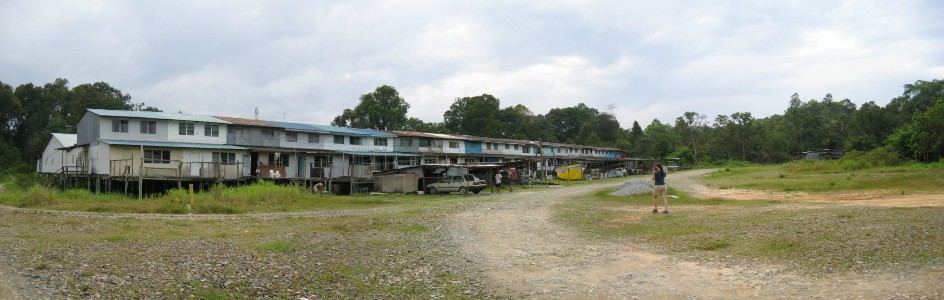
Out front of the newer longhouse |
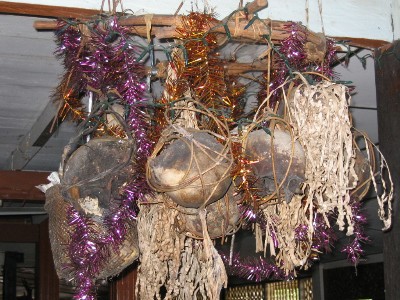
Leftover from the holidays, the people in this longhouse have a good
sense of humor about their skulls. |
After we had cleaned up from fishing we jumped back into Stewart’s van
and headed to the newer longhouse. We went through the usual exploring and greeting
the longhouse residents out on the porch, with a cameo appearance by Granny
Gone Wild, before Stewart’s uncle, Kenny, came up and offered to take
us into town in his car for drinks. We were all at various points of physical
exhaustion and car loathing, but Kenny was persistent. It seemed that he was
exceedingly proud of owning a car and wanted us to show it off. Finally we agreed
and he first took up to get drinks at a local store and then he paraded us into
the main square for even more drinks at a hawker center. I got the feeling Kenny
was showing us off to his buddies. He sat smoking and drinking beer, looking
quite pleased with himself. He was a very friendly guy though, so it was hard
to fault him.
We got back to Stewart’s mom’s, via an enthusiastic tour of Kenny’s
dwelling where he made us promise to come back some day and stay with him, just
in time to clean up for Stewart’s chicken curry. The food was excellent
and we passed the rest of the evening sitting on the mat, talking and watching
satellite TV. I zipped to CNN just in time to see a report saying that my man
Hunter S. Thompson had died from a self-inflicted gunshot wound. I was crushed.
Hunter, specifically his brilliant “Fear and Loathing in Las Vegas”
(the ultimate travel writing), is the reason that I started writing back in
college. He was nuts and did too many drugs and loved guns, so I guess something
like this was inevitable, but I was still shocked and disappointed. Rumor had
it that his health had been failing and perhaps he wanted to go out, literally,
with a bang rather than linger in a slow, painful, sedentary decline. From what
I know of Hunter, this seemed probable. Still, I think that Hunter would have
approved of me learning of his passing while sitting on the floor of an Iban
longhouse, drinking with the tribe (nevermind the satellite TV in the background).
I couldn’t mourn for too long because Kenny, now very, very drunk was
grabbing my arm. He was resolute that we all learn the entirely of the Iban
language that evening or die trying. I bowed out from the lessons early, still
half brain-dead from my sleep shortcomings.
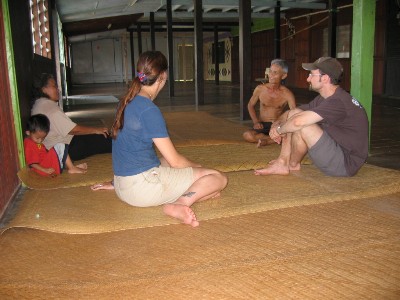
Kenny holds court |
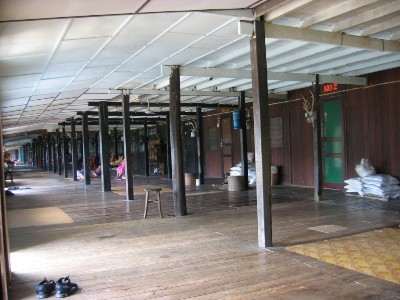
Communal porch |
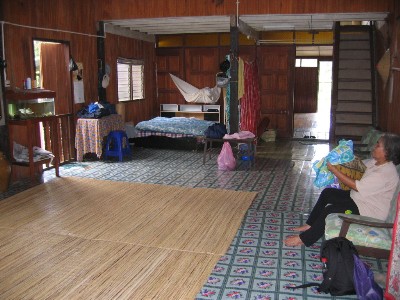
Living/sleeping area |
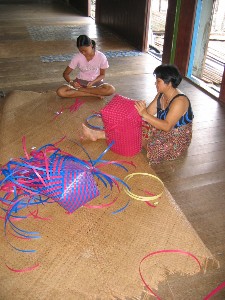
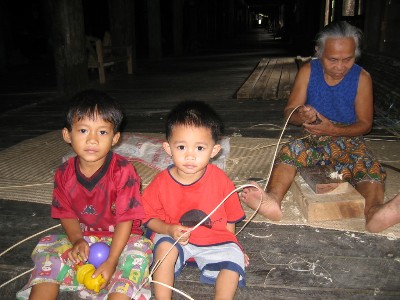
The next generation, weaving with plastic ribbons |
Like clockwork, the roosters went nuts for no reason at 5:00AM and I was reluctantly
up by 7:00. Stewart had gotten loaded with Kenny and was deeply hungover and
asked if I might like to drive the first leg. Malaysia is a left hand driving
country, like the U.K. Though I was marginally well-rested for the first time
in days, I wasn’t sure if I was up to the task of re-learning to drive
a stick-shift with everything reversed - I briefly was in command of a British
Landrover for six weeks while traveling Morocco in 1993 – and this would
be my first experience driving on the left side of the road. After two coffees,
I decided that I was ready for the challenge.
With the U.K. car configuration, not only is the stick shift on the left side,
enough of a mind-f*ck for one morning on it’s own, but the turn signal
and windshield wiper controls are reversed as well. To add to the fun, the pedals,
which are mercifully configured the same as the rest of the world, were smaller
than usual and very, very close together. Now I happen to have surprisingly
small feet for my size (which, ladies, is a feature that should not be read
into or assumptions drawn from in regards to other physical attributes), but
I was having a hard time hitting the gas square-on. More importantly, getting
my foot on the brake without fat-footing the gas at the same time was an ordeal.
Additionally, aside from the minor driving that I did at home in October and
a half day scooter rental in Greece in September, I had not been in command
of any kind of motor vehicle for over a year. Long story short, my passengers
were tense. Even semi-conscious, hungover Stewart looked regretful as we pulled
out onto the road and I immediately drifted to the right hand side.
After a few adjustments, I was fine and drove trouble-free for nearly two hours,
where we took a meal break and I handed the keys back to Stewart, so as to save
him the embarrassment of having to ask for them back.
Back in Kuching, I was a mess. No shower or shave for three days, minimal sleep
and jungle weary. I had intended to depart Kuching the next morning for an up-river
town called Kapit and then move even further upriver to the even smaller deep
jungle town of Belaga, but my comfortable air-con room in the Borneo B &
B and my need for about 17 hours of uninterrupted sleep convinced me to stay
an extra day. My time in Kuching had spiraled up from three nights to seven.
My concern about my overall trip getting out of control time-wise was already
stressing me out. I had a return ticket from Sydney to London for the first
week in May and if I as going to be continually delaying my travels I could
be on the road for a good year if I wasn’t careful. After the state the
I concluded my seven months of travel in Europe (utter zombification), I wanted
to avoid this kind of length at all costs. Even if it meant leaving with whole
countries chopped of my itinerary, but I had plenty of time to finesse that
contingency. For now, rest and an easy pace would have to take priority.
With the above on my mind, I made a rash, last minute change to my itinerary,
eliminating Kapit and Belaga all together and instead flying up the coast to
Miri. Although the allure of these quiet, jungle villages was tempting, these
destinations ultimately only had more longhouses to offer tourist-wise. I had
had my fill of longhouses and rather than do more of the same, I opted for something
completely different in the highlands. From Miri, it was a short flight - or
three day, horrendous, upriver cruise, needless to say, I was going to fly -
to the mountain village of Bario, population ~800, where I would get acquainted
with the Kelabit tribe and escape city life.
At the conclusion of my day of rest, Stewart took me to his family’s
house on the outskirts of Kuching for a goodbye dinner where they again fed
me rice wine like my total inebriation was of paramount importance. I was able
to convince them to get me back to the hostel by 1:00AM. After packing and showering,
I got five hours of drunken sleep before Stewart reappeared to take me out for
my last sobering laksa breakfast and then out to the airport for my flight to
Miri.
|